German Chancellor Merz urges Muslim immigrants who reject Holocaust responsibility to leave
Chancellor Friedrich Merz stated that immigrants from Islamic countries who do not accept Germany's historical duty regarding the Holocaust should depart, a comment made in response to fears expressed by Jewish athletes.
By Amir Navarro ·
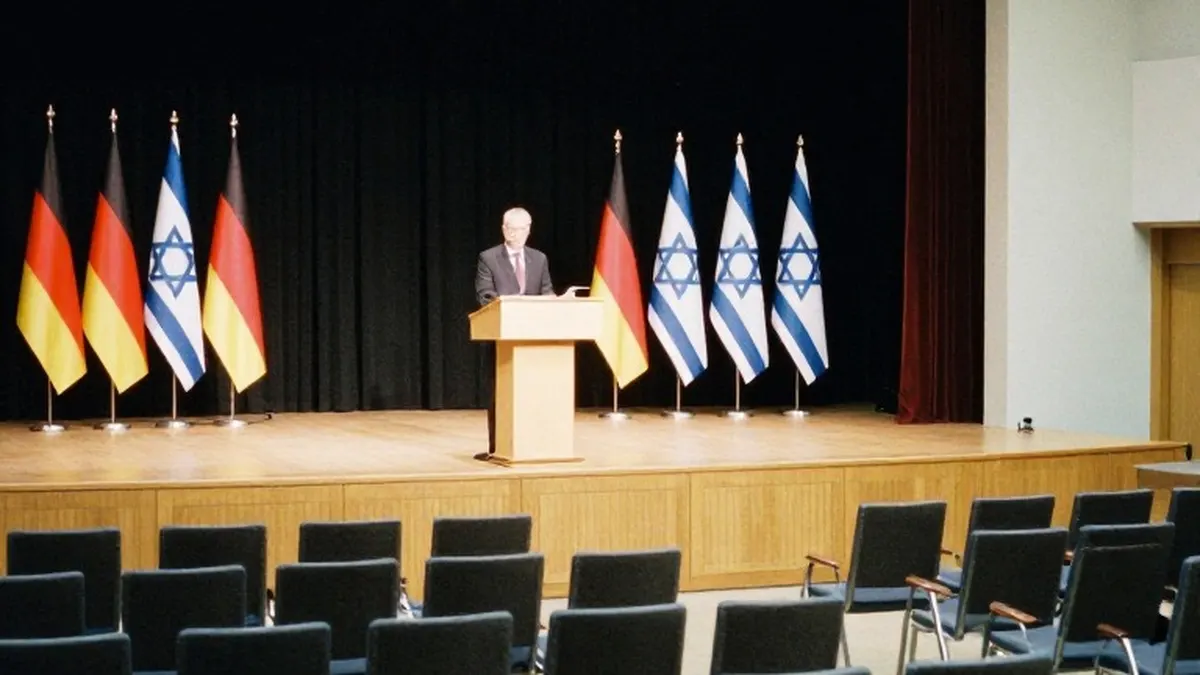
German Chancellor Friedrich Merz declared on Friday that Muslim immigrants who refuse to acknowledge Germany's historical responsibility for the Holocaust must leave the country. The statement was made during a reception in Berlin honoring Jewish athletes who represented Germany at the Maccabiah Games earlier this year.
According to the dpa German press agency, Merz emphasized that this historical duty applies equally to those arriving from Islamic nations. He asserted that anyone who does not abide by this principle should exit the country. The remarks followed a conversation with a basketball coach from the Maccabiah Games who reported that Jewish players on his team were afraid to wear their team jackets featuring the Star of David in public spaces.
To support his argument, Merz referenced a significant 1985 speech by former German president Richard von Weizsacke in the Bundestag. Von Weizsacke had stressed the necessity of recognizing and confronting Germany's role in the genocide of six million Jews during World War II. He noted that while younger generations were not responsible for the events of the Holocaust, they bore responsibility for its legacy.
Merz described von Weizsacke's words as set in stone and argued that they apply to German society as a whole. Given current circumstances, the chancellor added that this responsibility extends to immigrants who come to Germany. He suggested that accepting this legacy is a condition for remaining in the country.
The comments come amid persistently high levels of antisemitism in Germany. A report published this year by the Federal Association of Departments for Research and Information on Antisemitism, known as RIAS, recorded 2,197 anti-Jewish incidents in Berlin in 2025. These figures represented a decrease of about 13 percent from the 2,521 incidents recorded the previous year.
Despite the slight decline, the number of incidents remains more than double the levels seen before October 7, 2023. The RIAS report described an increasingly hostile environment where Jews and Israelis face harassment, intimidation, and violence in public spaces. The data highlights the ongoing challenges faced by the Jewish community in the capital.
Following the release of the report, a German legislator stated that the threat to Jewish life is worse than at any time since the Holocaust. This sentiment underscores the political and social pressure currently influencing discussions about immigration and identity in Germany.
Merz's address to the athletes serves as a public articulation of his government's stance on how newcomers should engage with German history. By linking the acceptance of historical responsibility to residency, the chancellor has introduced a specific criterion for integration that is likely to be debated in the coming weeks.
The Maccabiah Games, an international Jewish sporting event, provided the backdrop for these remarks. The presence of the athletes allowed Merz to directly address the concerns of the Jewish community regarding safety and recognition in public life. The event highlighted the intersection of sports, culture, and politics in contemporary Germany.
As the debate continues, the focus remains on how Germany balances its welcoming nature for immigrants with the expectation that they embrace its complex historical narrative. Merz's strong language signals a shift in how the government communicates these expectations to both domestic and international audiences.