Iraqi government and Kataeb Hezbollah reach deal to avoid clash over Jurf al-Sakhar
Baghdad and the Iran-backed militia agreed to a compromise that allows state forces to assume control of the southern stronghold, averting a potential military confrontation.
By Vanessa Lopez ·
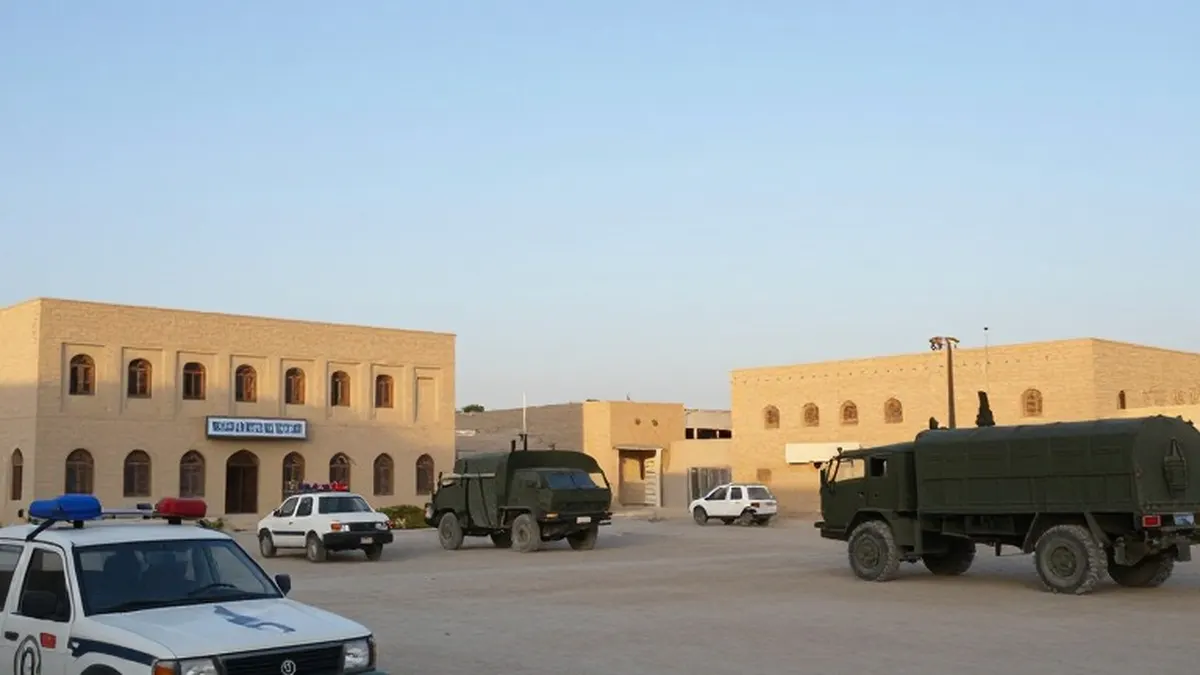
Baghdad has successfully negotiated a compromise with Kataeb Hezbollah regarding the control of the Jurf al-Sakhar stronghold. This agreement has narrowly prevented a direct conflict between the Iraqi state and the powerful Iran-backed paramilitary group, which had been on the brink of open combat.
The militia had previously been given a deadline of Friday to surrender control of the area in southern Iraq. Prime Minister Ali al-Zaidi had positioned security services near the outskirts of the town, preparing to enter by force if the deadline passed without resolution. Officials had accused Kataeb Hezbollah of operating a smuggling ring from the location that diverted hundreds of millions of dollars worth of state-owned oil.
According to three senior security officials speaking to Reuters on Thursday, a deal was finalized allowing Baghdad authorities to enter the town on Friday. Lieutenant General Saad Maan, who heads Iraq's Security Media Cell, stated that the armed group's forces would relocate to other areas. A new federal police headquarters in Jurf al-Sakhar will begin operations at 6am on Friday under the authority of the interior ministry.
The new command structure will be led by Lieutenant General Ahmed Hatem Hamid. He will be supported by deputy commanders Major General Hussein Ali Nassif for defence affairs and Adi Abdel-Imam Mussah for the Popular Mobilisation Forces. The agreement was brokered by senior Shia political leaders, with Esmail Qaani, commander of Iran's elite Quds Force, arriving in Baghdad late on Monday to assist in defusing the tense situation.
The shift in posture was significant, as Kataeb Hezbollah had vowed just days earlier that they would not leave their stronghold. Abu Taleb al-Saidi, a commander in the group, told AFP during a press visit that the dream of their withdrawal was impossible, stating it would not happen even over their dead bodies. The group claims to have tens of thousands of well-armed and well-trained members.
Hayder al-Shakeri, a research fellow at Chatham House, noted that all parties had strong incentives to avoid conflict. He warned that if Prime Minister Zaidi had continued pushing for a change on the ground while the militia refused to budge, a limited clash could have escalated rapidly. Other factions might have viewed such a clash as the beginning of a broader move against them. The deal provided a mechanism for both sides to retreat without appearing to fully surrender.
This confrontation occurs against the backdrop of the US withdrawing its forces from Iraq on 29 September, ending a presence that began 23 years after the invasion that overthrew Saddam Hussein. The pullout is linked to the disarming of extra-government armed groups that have become among the most powerful forces in the country since the fall of the former dictator.
Most of these groups were formed in 2014 following a call from Shia religious leader Ali Sistani to defend the country against the Islamic State group. However, the most powerful factions are older and, while officially part of the Hashd al-Shaabi or Popular Mobilisation Forces, they operate with significant independence and maintain loyalty to Iran. Prime Minister Zaidi has set a deadline of 30 June 2027 for these groups to disarm or come under direct state control.
The most influential groups, including Kataeb Hezbollah, Harakat al-Nujaba, and Kataeb Sayyid al-Shuhada, have already expressed their unwillingness to comply. During the US-led occupation and the war against the Islamic State, these groups were responsible for killing, kidnapping, and torturing thousands of Iraqis. They also helped suppress the pro-democracy Tishreen movement that erupted in 2019.
In recent years, several of these groups have united under the banner of the Islamic Resistance in Iraq to target Israeli and US assets in response to the ongoing conflict in Gaza. Hisham al-Mozani, an activist with the Al-Amal Association, warned in September that the push to disarm these militias risked returning the country to civil war. He estimated that the process of disarming and integrating the groups would take around five years, noting that some militias have existed for more than 40 years since the Iran-Iraq war and are deeply embedded in the political establishment, parliament, and ministries.