Iraqi government and Kataib Hezbollah agree to joint security force in Jurf al-Sakhar
Prime Minister Muqtada al-Sadr's government has reached a compromise with the Iranian-backed militia over control of a strategic area south of Baghdad, establishing a new joint operations centre.
By Amir Navarro ·
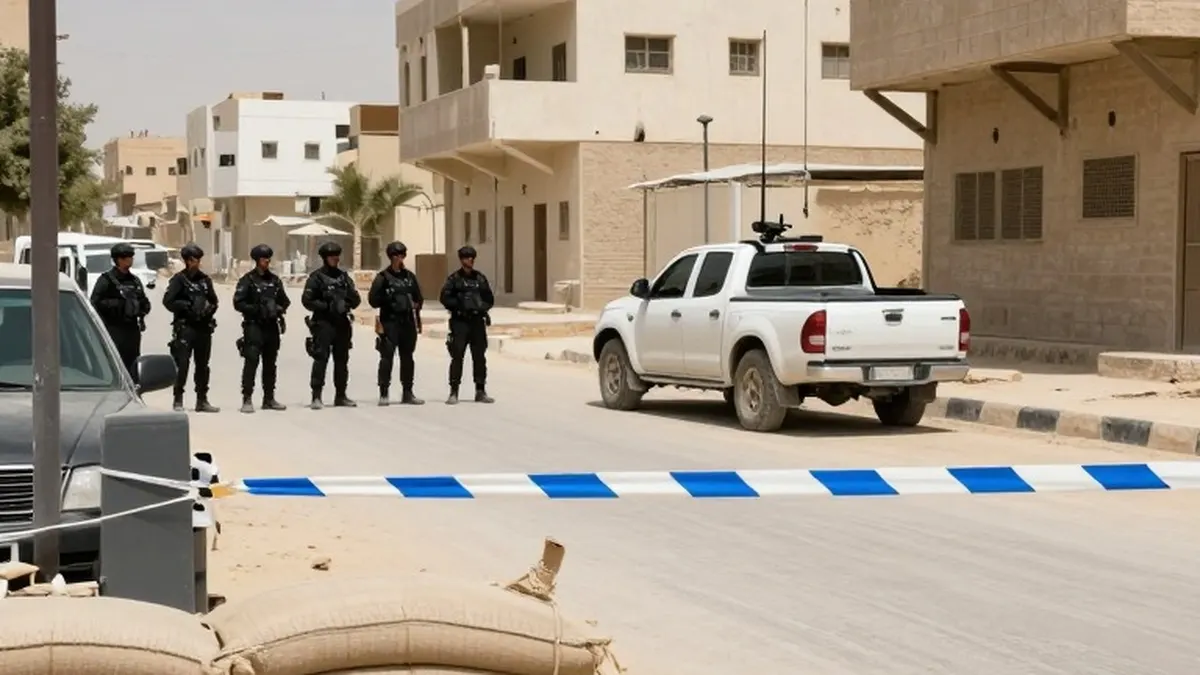
Iraq’s prime minister announced that security forces will establish a joint operations centre in the town of Jurf al-Sakhar. This move represents a compromise with Kataib Hezbollah, an Iranian-backed armed group, regarding the control of a strategic area located south of Baghdad. The agreement aims to stabilize a region that has long served as a stronghold for the militia.
The new arrangement follows a period of rising tension after the Iraqi government announced plans to deploy security forces into the area. These plans were driven by allegations that Kataib Hezbollah had been engaged in the smuggling of oil. The government sought to assert greater control over the region, leading to a potential standoff with the armed group.
The compromise was reached late on Thursday. Under the terms of the deal, a new combined force will be deployed to Jurf al-Sakhar. This multi-agency unit will consist of a brigade from the Iraqi Army and a brigade from the Federal Police. Additionally, a regiment from the Energy Police will be included specifically to provide protection for the oil pipelines situated in the area.
The deployment will also feature two brigades from the Popular Mobilisation Forces Commission. The PMF is a collection of armed groups that are officially integrated into Iraq’s security forces. This body includes fighters from various militias, some of whom are members of Kataib Hezbollah itself, creating a complex but integrated security presence.
In a formal statement, the commander-in-chief of Iraq’s armed forces confirmed that the new joint operations centre is scheduled to open at 6am local time on Friday. This corresponds to 03:00 GMT. The establishment of this centre marks a significant shift in how security is managed in the volatile district.
Prior to the agreement, a senior Iraqi official told Al Jazeera that Kataib Hezbollah had been given until Friday to leave Jurf al-Sakhar. The armed group had previously threatened to confront government troops if the deadline was not met. They had also rejected broader government efforts to disarm non-state militias, highlighting the friction between the central government and powerful local factions.
The resolution comes amidst broader regional dynamics. Earlier in the week, an Iraqi official revealed that Esmail Qaani, the commander of Iran’s Islamic Revolutionary Guard Corps Quds Force, arrived in Iraq. His visit was aimed at pushing for a solution to the simmering tensions between Baghdad and Tehran, which had been exacerbated by the dispute over Jurf al-Sakhar.
The involvement of Iranian leadership in the mediation process underscores the significant role Iran plays in Iraqi security affairs. By reaching a compromise, both the Iraqi government and Kataib Hezbollah have avoided a direct military confrontation that could have had wider implications for regional stability.
The new joint operations centre is expected to coordinate efforts between the various security branches involved. The inclusion of the Energy Police is a specific response to the oil smuggling allegations, aiming to secure revenue streams while maintaining the political balance with the militias. This approach seeks to blend military presence with political accommodation.
As the new force begins its operations, observers will watch closely to see if the agreement holds. The integration of different security forces, including those with ties to the very group that controls parts of the area, presents both challenges and opportunities for long-term stability in the region south of Baghdad.