First-Time Voters Could Decide Up to 12 Knesset Seats as Israel Heads to the Polls
About 640,000 Israelis aged 18 to 22 can vote in Tuesday's election, and researchers expect high turnout driven by worries over security and the cost of living.
By Amir Navarro ·
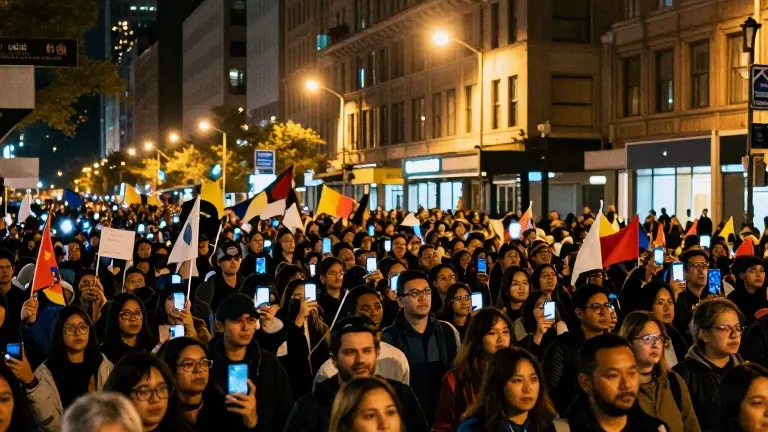
Israelis vote on Tuesday, Oct. 27, in an election where first-time voters could carry unusual weight. The Israel Democracy Institute (IDI) estimates that 640,000 people aged 18 to 22 are eligible to cast a ballot. They make up nearly 10% of the electorate, and their choices could decide as many as 12 seats in the 120-member Knesset.
One of them is Yael Chernyvsky, 18, from Ramat Hasharon. She told the Jewish Telegraphic Agency earlier this month that she is voting "so we can change the future of this country." She spoke before an event in a Tel Aviv auditorium where leading politicians were due to address more than 1,000 first-time voters, many of them in pre-military programs. Chernyvsky, who is in an army preparation program in the Negev, blames the government led by Prime Minister Benjamin Netanyahu for the country's problems. She has not settled on a party but said she will "probably" back either the Democrats, led by Yair Golan, or Yashar, led by Gadi Eisenkot. Both belong to the opposition "change bloc," which wants to remove Netanyahu. He has been in office since 2009, apart from a brief break in 2021 and 2022.
Tammy Hoffman, head of the education policy program at the IDI, said the institute co-sponsored the event with the Yigal Allon Center. "Israel is a young country with a high birth rate," she said. "If their turnout is high, as our research suggests, first-time voters will make a difference."
In May, the IDI surveyed prospective first-time Jewish and Arab voters. Across population groups, 80% to 95% said they would definitely or probably vote. Secular Jewish youth were the most certain, and 87% of Arabs said they intend to vote. That compares with a youth turnout of 47% in the 2024 US presidential election, according to the Center for Information and Research on Civic Learning and Engagement. A separate poll for Ynet and Yedioth Ahronoth found 67% of young respondents certain they would vote and another 19% thinking they would.
In both surveys, national security and the cost of living ranked highest among Jews and Arabs. Hoffman said that was no surprise, noting that these young people were in junior high during COVID, saw the judicial reform protests, and lived through Oct. 7. "They are worried about their future," she said.
Political leanings are harder to pin down. Hoffman noted that Jewish Israeli voters of all ages have moved rightward over the past couple of decades, but said military service "can do the opposite," because it can raise questions about the war and its goals. An N12 poll on Sept. 23 found 74% of young people describing their views as right-wing or center-right and 23% as left-wing or center-left. In that poll, 16% would vote for Eisenkot's Yashar and 14% for Netanyahu's Likud. Hoffman added that mock elections at high schools showed most students backing Yashar and Beyachad, led by former prime ministers Naftali Bennett and Yair Lapid, with some support for Likud but little for Itamar Ben-Gvir's far-right party.
Individual voters reflect that range. Omer Gross of Jerusalem, now in an army-prep program in the Golan, plans to back the Religious Zionist party led by Bezalel Smotrich and Moshe Feiglin. He disagrees with Smotrich's approach in Gaza but supports his policies in the West Bank, saying, "We need a strong, secure Israel." His program-mate Tomer Shiloh, 18, of Herziliyah, will vote for the change bloc and wants the next government to require ultra-Orthodox men to serve in the IDF and to lower living costs.
A 22-year-old reservist, identified as Sgt. M because IDF regulations require anonymity, said universal service is his top priority but that he will vote for the Democrats mostly on economic grounds, citing the cost of tuition, books, food and housing. Khalel Alaa Sabeh, 18, of Shef-Amra, wants an Arab party that will close resource gaps in Arab communities and tackle crime. He said he is urging friends to vote and, whatever the result, "I won't leave the country. This is my land, this is my home."
Source: The Jerusalem Post