Coyote beats December date by crossing new wildlife bridge
A coyote was filmed traversing the Wallis Annenberg Bridge over Highway 101 in Agoura Hills weeks before its scheduled opening.
By Marina Weber ·
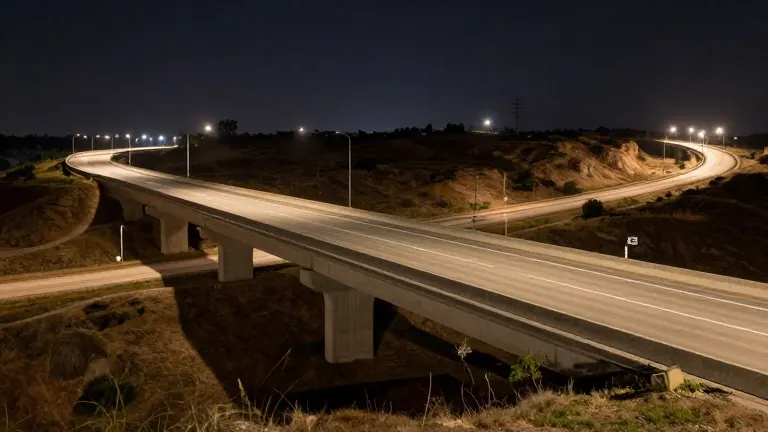
A coyote became one of the first animals to fully cross the Wallis Annenberg Bridge in Agoura Hills, California, weeks before the structure’s official opening. The animal crossed the bridge over Highway 101 from south to north at 1:35 a.m. on Thursday. Two remote cameras captured the event. The bridge is scheduled to open officially to wildlife on December 2.
Construction work on the bridge is proceeding at a fast pace. The coyote did not wait for the formal ceremony. Beth Pratt, leader of the Save L.A. Cougars campaign, was notified of the sighting early Thursday morning. Jeff Sikich, a biologist with the National Park Service, reported the observation to her. Sikich confirmed that the animal was a coyote moving north on the highway overpass. He stated, “We have a winner! It was a coyote, over the 101 structure, heading north. It was captured by two cameras.”
Sikich and Pratt had made personal predictions about which species would be the first to use the bridge completely. Pratt bet on a mule deer. Sikich chose the coyote. The coyote was also the most popular choice in an online poll. It received 34 percent of the votes. The Save L.A. Cougars campaign shared the news on social media. They noted that wildlife has its own inauguration date. The organization expressed excitement at seeing the animal use the structure before the ceremony.
National Park Service biologists are installing remote monitoring cameras as part of a long-term scientific research program. These devices will document which species approach and use the bridge. They will also record the timing of crossings and how animals respond to the new connection. The bridge links the Santa Monica Mountains with the Simi Hills. Seth Riley, director of the wildlife division for the Santa Monica Mountains National Recreation Area, explained the goal of the study in a statement. He said, “This goes beyond determining if animals use the bridge.” Riley added, “We want to understand how effective it is for reconnecting an ecosystem that has been divided by the highway for decades. That is a much broader scientific question and answering it will take years.”
The Wallis Annenberg Bridge was designed to reconnect natural habitats fragmented by Highway 101. It allows mountain lions and other species to move safely between the mountain ranges. The structure aims to reduce the risk of vehicle collisions for wildlife in the region. The bridge serves as a critical corridor for maintaining genetic diversity in local populations. The installation of the cameras marks the beginning of the data collection phase for this ecological project.