Poland's Independence Day march draws record crowd amid political tension
Tens of thousands gathered in Warsaw for the annual nationalist demonstration, a day after leaders called for unity following a tragic shooting in Krakow.
By Amir Navarro ·
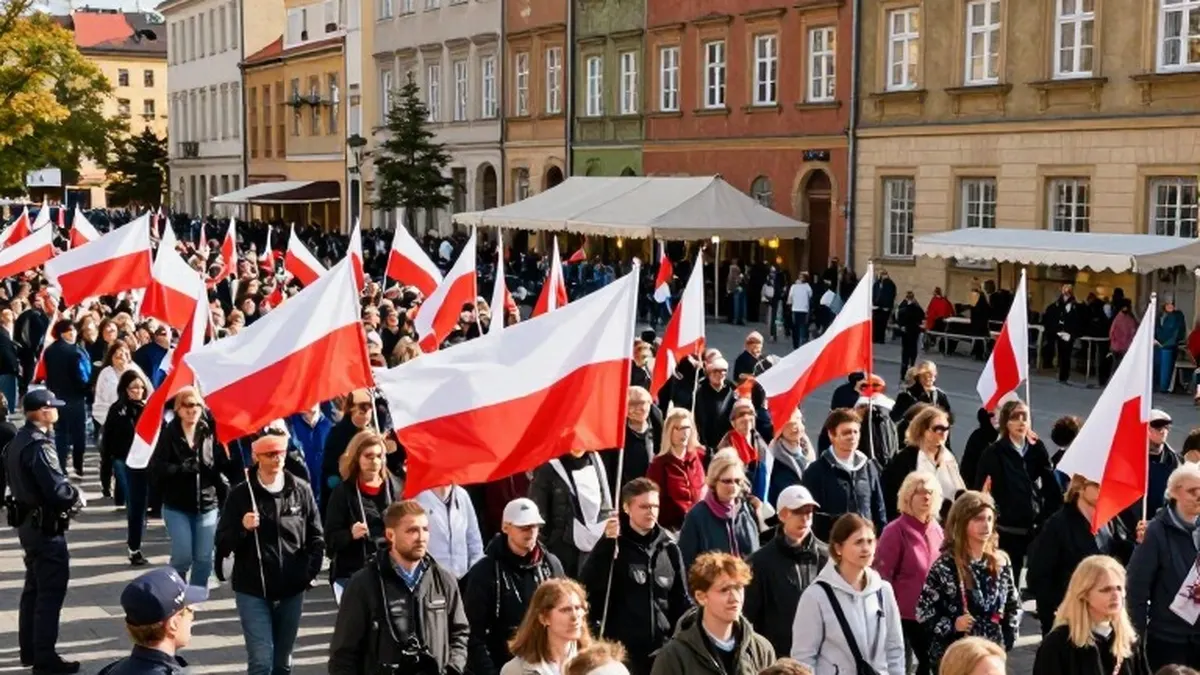
Warsaw, Poland, experienced a significant display of nationalist sentiment on Wednesday as tens of thousands of participants joined the annual Independence Day march. The gathering took place in the heart of the capital, with crowds carrying Polish flags as police officers maintained a strong presence to secure the routes and manage the demonstration. The event occurred just days after a mass shooting in the city of Krakow claimed six lives, adding a layer of gravity to the already politically charged atmosphere.
The march commemorates November 11, a date that marks the end of more than a century of partition by Russia, Prussia, and Austria. Since 1918, this day has served as a focal point for national pride, though it has also been a recurring source of friction between right-wing groups and Poland's current centrist government. Critics have frequently pointed to the event as a platform for anti-immigration and anti-Semitic rhetoric, while supporters emphasize its role in expressing collective identity under the motto, “A Pole is the host in Poland.”
Organizers anticipated a record turnout for this year's procession, noting the presence of numerous foreign nationals. Among the expected attendees were members of Spain's Revuelta, a youth movement associated with the Vox party, as well as representatives from the Hungarian far-right party Mi Hazank. The convergence of international figures highlighted the growing transnational connections within the European nationalist movement.
President Karol Nawrocki, a conservative-nationalist, was observed participating in the march. He has attended the event in previous years both in his official capacity and as a private citizen. During the demonstration, Nawrocki addressed the crowd with remarks that subtly criticized the governing coalition. He stated that Poland does not exist for political elites to manage citizens against the will of the nation, a comment that resonated with those viewing the event as a counterpoint to centrist policies.
In the lead-up to the march, Prime Minister Donald Tusk urged participants to exercise restraint. His appeal came in the wake of heightened political divisions following the revelation that the shooter in Krakow may have been motivated by far-right ideology. Tusk emphasized the importance of shared values, noting that despite political opposition, those who care about Poland must recognize independence, freedom, and a secure republic as common goods that transcend party lines.
The tragedy in Krakow occurred on Saturday, November 7, when a gunman opened fire from his vehicle in the main square. The 24-year-old attacker killed six people and wounded more than a dozen others before being shot by police officers and taken into custody. He was later transported to a hospital, where he died on Monday following his arrest.
The potential ideological motivation of the attacker has intensified the political discourse surrounding the Independence Day celebrations. On Tuesday, Justice Minister Waldemar Zurek revealed that the killer had shown an interest in Anders Behring Breivik, the neo-Nazi who carried out a mass killing in Norway in 2011. This detail has fueled debates about the influence of far-right ideologies on domestic politics and public safety in Poland.
As the march concluded, the visual spectacle of thousands of flags and banners underscored the enduring passion of the nationalist base. However, the recent events have prompted a broader reflection on how Poland navigates its historical memories and contemporary political challenges. The juxtaposition of celebration and mourning has left many citizens grappling with the balance between asserting national identity and fostering national unity.
The police deployment during the event was notable for its scale, reflecting the authorities' desire to ensure the demonstration proceeded safely amidst the recent shock. No major incidents were reported during the Wednesday gathering, allowing the participants to complete their route through central Warsaw. The event serves as a key indicator of the current political mood in the country, highlighting both the strength of the nationalist movement and the ongoing efforts by the centrist government to maintain stability.