Iran Retains Capacity to Build About 50 Ballistic Missiles a Month, Report Says
An intelligence estimate reported by Bloomberg suggests Iran retains substantial missile production capacity despite US and Israeli strikes on its industrial infrastructure.
By Marina Weber ·
Iran can manufacture approximately 50 ballistic missiles each month despite damage sustained during the recent war, according to an intelligence estimate cited by Bloomberg on Wednesday. That represents roughly half its production capacity before the conflict, indicating that months of US and Israeli airstrikes, sanctions and a blockade have not eliminated its ability to replenish its arsenal.
The strikes were conducted under operations Roaring Lion and Epic Fury. Beyond its remaining ballistic missile production, Iran may also retain a substantial stockpile of attack drones. Jim Lamson, a research fellow in the Department of War Studies at King’s College London and a former CIA Middle East analyst, told Bloomberg that thousands of Shahed-type strike weapons could remain. Those unmanned systems include one-way attack variants with characteristics that overlap with cruise missiles.
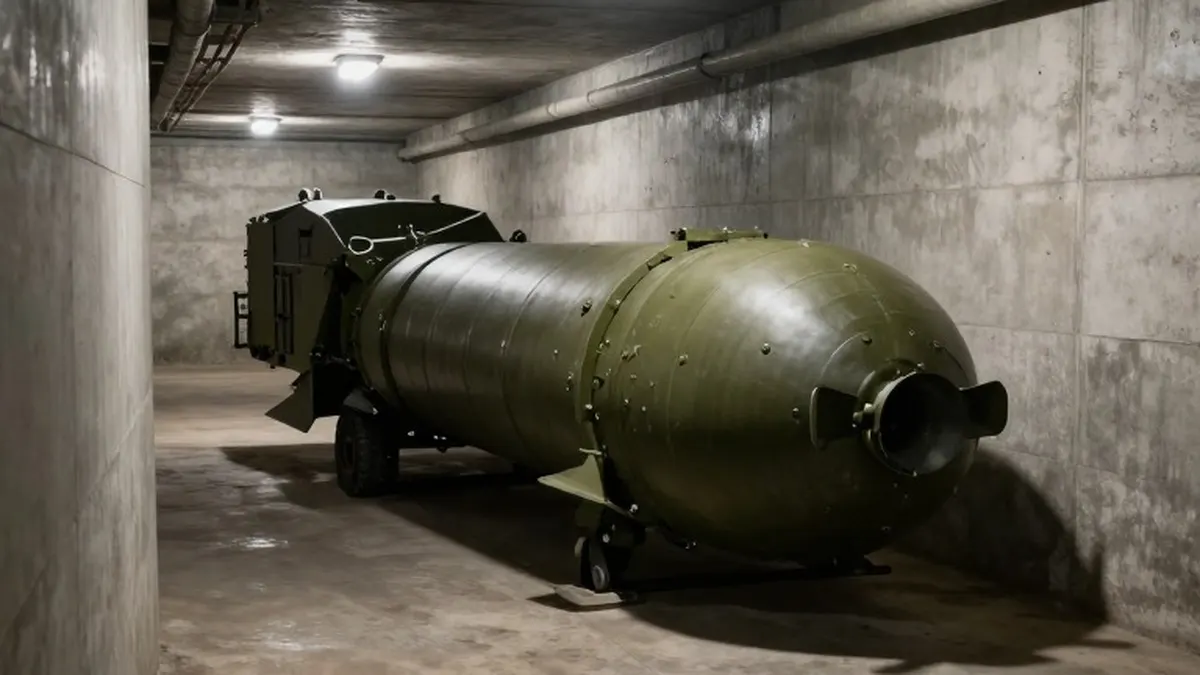
Iran has sought to demonstrate the survival of its weapons capabilities by displaying an underground installation it described as a new missile city. Footage presented by the Islamic Revolutionary Guard Corps showed ballistic missiles, cruise missiles and launchers. Fatah-1 medium-range ballistic missiles appeared to occupy much of the facility.
Maj.-Gen. Ali Abdollahi, chief of staff of Iran’s armed forces, said advanced missiles would surprise Iran’s opponents through their battlefield effects. He also warned that another attack on Iran would bring a response extending beyond the region. The display underscored Tehran’s effort to portray its missile forces as intact despite American and Israeli bombardment.
On November 11, the IRGC presented its Fatah-2 hypersonic missile after Israel’s Rafael Advanced Defense Systems unveiled the Super Ice cruise missile. The Fatah-2 reaches speeds of up to 18,500 kilometers per hour during portions of its flight. Some analysts fear Iran could eventually develop the ability to reach the mainland United States by combining its multistage satellite launch technology with its intercontinental ballistic missile infrastructure.
According to the Institute for the Study of War, Iran has formally dropped its self-imposed missile range ceiling of 2,000 kilometers. It has also begun threatening US bases in Europe with strikes if those installations are used to launch attacks against it.
The production estimate contrasts with earlier declarations by Israeli Prime Minister Benjamin Netanyahu and US President Donald Trump. In March, Netanyahu said that after 20 days of war, Iran could neither enrich uranium nor manufacture ballistic missiles. Trump made similar statements after the war and said on November 9 that almost 85 percent of Iran’s manufacturing capability had been destroyed, while warning that US forces remained prepared to act.
Both leaders have prepared for renewed strikes over reported advances in Iran’s nuclear weapons program. Last week, retired Rear-Adm. Robert Stiles Howard, a former deputy commander of US Central Command, described the failure to eliminate Iran’s ballistic missile and drone capabilities as potentially the war’s most significant failure.