Haitians express hope in Bukele as Salvadoran troops continue anti-gang operations
Thousands of Haitians rallied to support El Salvador's military presence, while experts warn that current tactics lack a sustainable long-term strategy for national security.
By Marina Weber ·
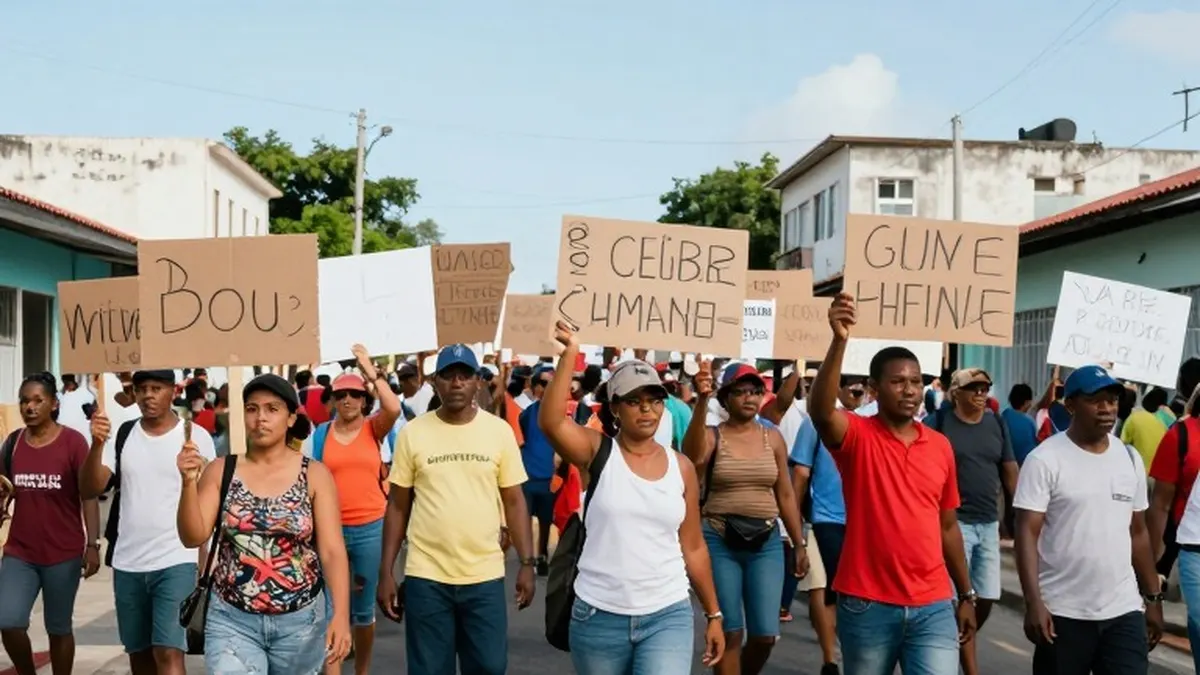
Thousands of demonstrators filled the streets of Port-au-Prince and other areas of Haiti on Tuesday to show their support for El Salvador's President Nayib Bukele. The crowds cheered as Salvadoran forces intensified their campaign against local gangs, with many participants holding signs urging the president to persist in his efforts. One sign read that Bukele must keep fighting or the gangs would eventually kill everyone, while others called for the use of explosive drones and robot dogs that have recently appeared in the capital.
Haitian Justice Minister Patrick Pelissier, who is currently visiting El Salvador, told reporters that there is no specific date for the Salvadoran troops to withdraw. He explained that their support is essential to reinforce the Haitian police force until national elections are held next year. The government also announced that the Council of Ministers has ratified a cooperation agreement between the two nations, although specific details of the deal have not yet been released.
The deployment of approximately 2,500 Salvadoran troops began last month after four of their own soldiers were attacked on October 18 and remain missing. Since then, clashes between gangs and foreign forces backed by the Haitian government have escalated. The Caribbean nation remains trapped in a cycle of violence, with more than 20,000 people killed over the past five years and gangs estimated to control 70% of the capital.
Citizens expressed deep gratitude for the military intervention. Maxseau Lomba, a participant in the march, stated that the gangs had driven them from their homes and killed their children. He described Bukele as a father figure to the people. Marie Michelle Dorville, a street vendor, shared a similar sentiment, noting that the gangs killed her partner and left her to raise three children alone. She called on Bukele and the police to eliminate the gangs permanently so that citizens could resume normal lives.
Sam Vigersky, a fellow at the Council on Foreign Relations, noted that the public enthusiasm is understandable. He observed that El Salvador deployed more troops in two weeks than the United Nations backed mission did in over a year, which has revived a sense of hope among many Haitians who had long felt abandoned by international efforts.
Despite the public support, experts caution that the current approach may not be sustainable. Diego Da Rin, an analyst with International Crisis Group, warned that the current enthusiasm could turn into anger if the troops withdraw without a clear plan. The group released a report based on over 100 interviews, highlighting government failures and urging officials to prepare for the day when international forces leave.
The report emphasized that the foreign mission offers temporary relief rather than a permanent solution. It stated that the goal is to weaken gangs, not dismantle them entirely. The group also noted that authorities lack a strategy to coordinate efforts and reduce violence in the long term. A cartoon in the newspaper Le Nouvelliste illustrated this point by depicting Haitians cheering near a table with a paper labeled PLAN ANTI GANG, highlighting the absence of a formal strategy.
Challenges within the Haitian National Police also complicate the situation. As of last year, the force had no more than 8,000 active officers for a population of nearly 12 million. Many of these officers hold administrative positions and are not on the street, while others lack combat training. The government has shortened training periods from seven months to less than four to quickly expand the ranks. Additionally, promotions often do not follow merit or seniority, leading some lower-ranking officers to seek additional income through private security or arms trafficking.
International Crisis Group recommended improving salaries, benefits, and facilities for police officers, along with providing specialized training and a clear promotion system based on performance. The report also noted that the use of helicopters and explosive drones has brought diminishing returns in terms of territorial control. At least 87 civilians, including 21 children, were killed by drones between July 2025 and September 2026, according to the United Nations.
Salvadoran Vice President Felix Ulloa stated that the bilateral agreement with Haiti would not be made public, suggesting a hidden agenda to criticize the operation. Salvadoran Security Minister Gustavo Villatoro added that soldiers would return home once the four missing technicians are found. He emphasized the need to prepare Haiti for a genuine rule of law so that its institutions function effectively in the future.