Afghan Farmers Drive Poppy Boom to Pakistan's Borders
Satellite data reveals over 9,000 hectares of new cultivation in Balochistan as Afghan growers cross into neighboring regions.
By Marina Weber ·
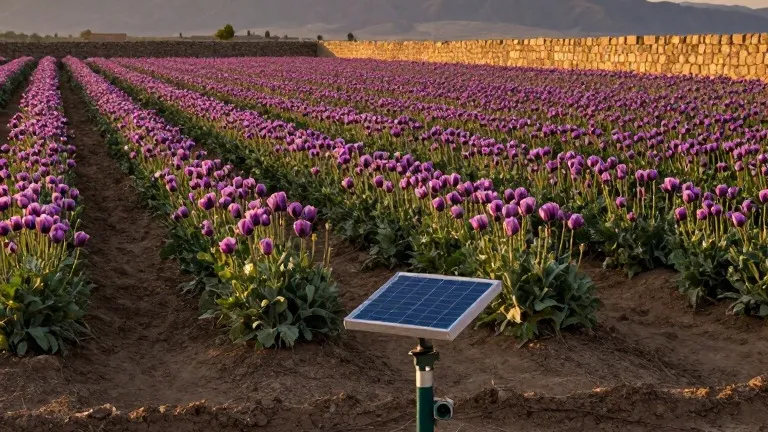
Afghan farmers are moving their poppy operations across the border, turning the remote lands of Pakistan and Iran into a new hub for opium production. The shift follows the Taliban's 2022 ban on narcotics in Afghanistan, which drastically cut domestic output but failed to stop cultivation entirely. Now, growers from Kandahar and Helmand are leasing land in neighboring countries, bringing capital and experience to regions previously focused on fruit farming.
David Mansfield, a UK-based expert on illicit drugs, said the instability in the tri-border area created ideal conditions for this expansion. According to an August report by the British firm Alcis, satellite imagery identified more than 9,000 hectares of poppy cultivation in Pakistan's Balochistan province alone. The majority of these fields are located in the districts of Loralai and Killa Abdullah. Mansfield described the area as becoming a global center for opium production, noting that the surge in planting signals higher yields expected in 2027.
Local officials in Killa Abdullah dispute the scale of the growth. Monawar Hussain, the district's chief administrative officer, stated that cultivation declined after an eradication campaign last year. However, Alcis imagery from 2026 shows no clear evidence of large-scale destruction. Abdul Qahar Wadan, a former National Assembly member, claimed that senior military officials and pro-government figures are backing the growers in exchange for commissions. Islamabad has denied the existence of widespread opium cultivation, though the United Nations Office on Drugs and Crime acknowledged that sharp rises in eradication figures point to spillover effects.
Farmers in the region say the shift is driven by economic necessity. Lala Jan Kakar, a resident of Killa Abdullah, explained that drought and flash floods have devastated traditional fruit crops. "It's not possible to resist it anymore. The demand for poppies is much more than fruits, and so is the income," he said. Afghan tenants are investing millions of rupees in solar-powered wells and sharing profits with local landowners. Poppies can be harvested twice a year, and many farmers doubled their cultivated land in 2026.
A similar pattern is emerging in Iran's Sistan-Baluchistan province. Afghan farmers are working as tenants there, utilizing family ties to secure land. Satellite imagery shows extensive fields in 2026, some equipped with drip irrigation. This costly infrastructure suggests growers planted in late 2025 with little fear of eradication. Mansfield noted that farmers are moving away from mixed farming toward large-scale poppy monoculture in these border regions.
Inside Afghanistan, production is also rebounding despite the ban. Cultivation in northeastern Badakhshan Province accounts for roughly half of the national output. In the southwest, cultivation almost doubled between 2025 and 2026, with crops hidden behind compound walls and within wheat fields. Mansfield warned that a Taliban directive barring home searches without a court order might be read as tolerance for wider planting, potentially leading to a dramatic rise in production in 2027.
Source: RFE/RL