Suffolk Village Votes for Symbolic Independence Over Asylum Camp Plans
Residents of Barnham voted to seek crown dependency status in a symbolic referendum protesting government plans to house 930 asylum seekers at a nearby former military base.
By Vanessa Lopez ·
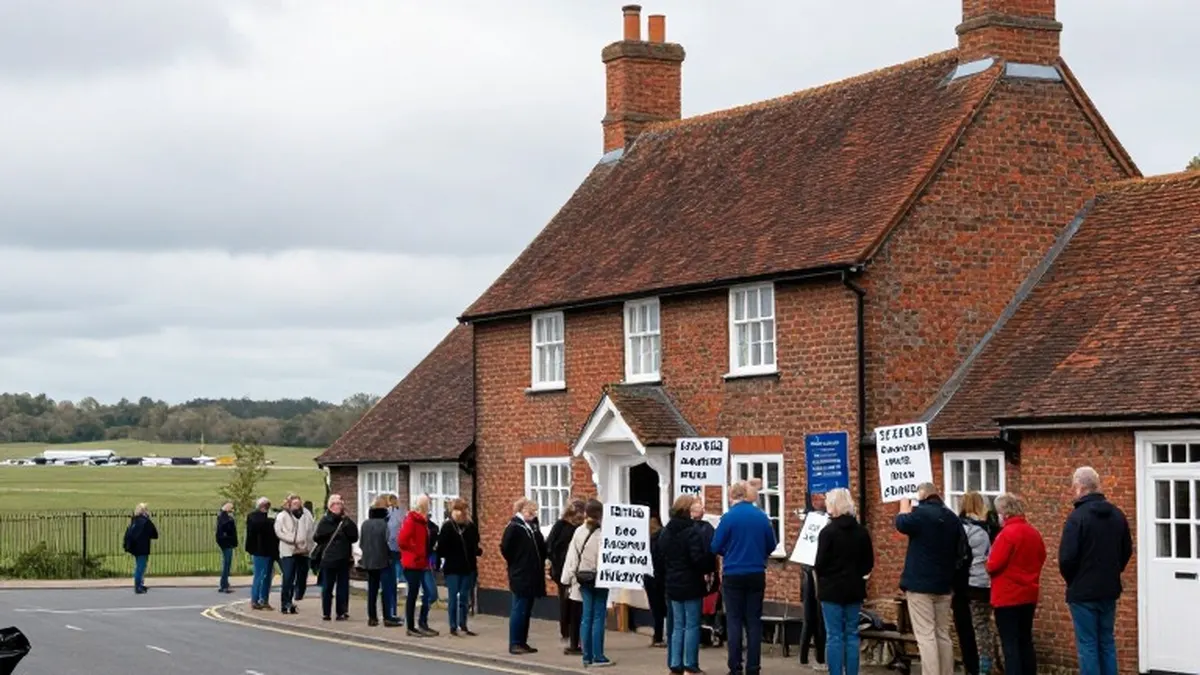
Residents of Barnham in Suffolk held a symbolic referendum on Saturday, voting to separate themselves from the United Kingdom. The vote was organized in response to government proposals to accommodate 930 asylum seekers at the nearby former military base known as RAF Barnham. Approximately 500 people were eligible to participate in the non-binding poll, which resulted in 257 votes in favor of independence, 16 against, and one spoiled ballot.
Helen Beck, chair of the Barnham Residents’ Association, announced the design of a local flag for the prospective independent entity. She described the symbol as a stone-curlew on a Suffolk blue background. The stone-curlew is a rare bird that nests in the area, a fact that has become central to the local debate over the proposed development.
RAF Barnham was identified in June as one of three Ministry of Defence sites selected for new developments to house asylum seekers. This is not the first time a village has held a similar vote. In September, residents of Piddington in Oxfordshire also voted to leave the UK following plans to house more than 1,000 migrants at another former military base. In Barnham, the plans have already triggered protests outside the site.
The referendum asked voters whether they supported seeking crown dependency status, a political arrangement similar to that of Jersey, Guernsey, and the Isle of Man. John Bauer, the parish council chair, explained that this status would allow the village to maintain loyalty to the crown while removing itself from the jurisdiction of the Home Office.
Local MP Dr Peter Prinsley, a Labour member, expressed his opposition to the site's development before the vote took place. He characterized the plans as resembling a concentration camp and warned that securing planning permission could be difficult due to environmental concerns. He noted that previous development applications nearby had been rejected because of the presence of rare species, particularly stone-curlews.
Prinsley stated that while he expected the result to be heavily in favor of independence, the referendum was symbolic and not binding. He highlighted that the government is working to address irregular migration, with net migration potentially falling to near zero by the end of the year. However, he argued that large army camps in remote locations are rarely appropriate for distributing people seeking asylum.
The MP emphasized that people arriving on small boats are seeking asylum rather than being illegal migrants. He criticized the site for being remote, lacking pedestrian access, and sitting on a hazardous main road with a history of serious accidents. He also pointed out that the site is a designated site of special scientific interest due to the stone-curlews, which enjoy worldwide protections that make planning applications complex.
Prinsley suggested that disused office blocks in larger cities might be more suitable for housing asylum seekers, as these locations offer better access to local services. He added that the proposed site does not feel like a compassionate environment for those fleeing persecution. He also noted that legitimate local criticism has been co-opted by opposition parties aiming to stir up racial discord.
Political dynamics have shifted regarding this issue. The Labour party previously criticized the Conservative policy of using military bases for asylum housing, but has since adopted a similar approach in government. The Conservative party has reversed its position, with leader Kemi Badenoch telling villagers on Friday that the party is on their side. She stated that the government has a plan to stop the problem of small boats.
A Home Office spokesperson acknowledged the strong feelings within the local community. The department stated that it is working to distribute asylum accommodation more fairly across the country, having saved over one billion pounds in costs since the election. This includes closing asylum hotels and moving to alternative accommodation, such as former military sites, which are designed to be self-contained with 24/7 security and CCTV to minimize impact on local residents.
Construction company Kier was announced earlier this month as the firm that will design the new camp at RAF Barnham. The outcome of the symbolic vote is expected to add further pressure on the government as it moves forward with its housing plans.