North Korea unveils wave of new barbecue restaurants
State media reports over a dozen openings since September, featuring marble tables and ostrich, despite ongoing food shortages.
By Vanessa Lopez ·
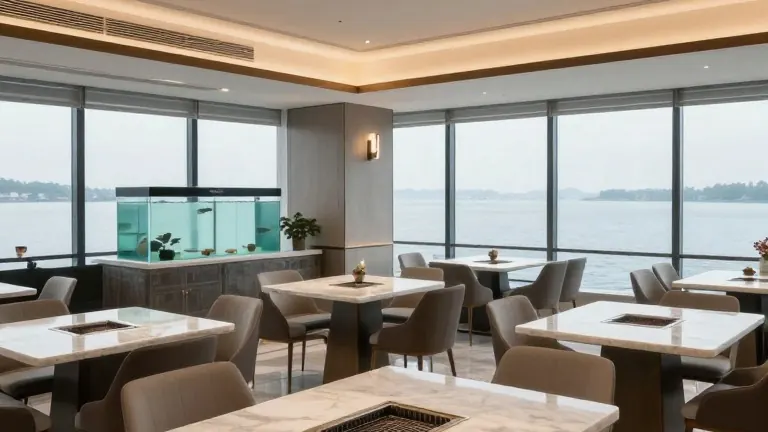
Residents of North Korea are facing a sudden change in the national dining scene as the state promotes a network of large, multi-story barbecue establishments. Since September, state media channels have announced the opening of more than a dozen new venues across the country. These restaurants feature distinctive architectural elements, including waterside terraces and marble tabletops built with metal grills. The menus displayed in state broadcasts include beef, pork, and ostrich, items that remain rare for the average citizen.
The timing of these announcements stands in sharp contrast to the country's ongoing food security challenges. According to the latest report from the United Nations food body, more than two out of every five North Koreans are currently undernourished. This statistic highlights a persistent gap between the image projected by the government and the daily reality of many residents who struggle to access enough calories for a healthy diet.
Benjamin Katzeff Silberstein, head of Korean Studies at the Hebrew University of Jerusalem, noted that meat serves as a potent symbol for the regime. He linked the current boom to a long-standing promise made by former leader Kim Il Sung, the grandfather of current leader Kim Jong Un, to provide the population with white rice and meat soup. Silberstein suggested that the expansion of these dining options indicates an effort to demonstrate that prosperity is reaching areas beyond the capital city of Pyongyang.
Specific examples of the new establishments illustrate the scale of the project. A new restaurant in Sinuiju, located on the border with China, rises three stories high. In northern Kanggye, the interior design includes a fish tank where patrons can drink draft beer. An opening ceremony in the west coast city of Nampo featured a display of fireworks. Several of the new venues advertise floor plans large enough to seat hundreds of guests simultaneously.
Hazel Smith, a research associate in Korean Studies at the University of London, offered a more cautious interpretation of the trend. She argued that the restaurants do not signal a thriving economy, but rather indicate that specific groups, such as those in trade and construction, are benefiting from growing economic ties with Russia. "This is not a sign that you’ve got a thriving economy, it’s a sign that some people at the moment are able to get by and afford to go out and have a meal now and then," Smith said.
The spread of these leisure facilities mirrors earlier expansions of waterparks, coffee bars, and high-end shopping malls. While Kim Jong Un has not yet been photographed at these specific openings, high-ranking local officials typically attend such events. South Korea's central bank reported in July that the North Korean economy grew by 3.5% in 2025, marking the third consecutive year of growth above 3%.
Historical context adds weight to the skepticism surrounding the new venues. During the famine of the 1990s, the state distribution system collapsed, leading to the deaths of hundreds of thousands of people. Since then, semi-private markets and support from China and Russia have provided some stability. UN Comtrade data shows that meat imports from China more than quadrupled between 2023 and 2025, reaching nearly $39 million. Joung Eun-lee, director of the North Korean Research Division at the Korea Institute for National Unification, stated that rising imports prove domestic production cannot meet demand. She described the media coverage of the restaurant openings as a powerful form of propaganda.
Lee Ae-Ran, who defected from North Korea in 1997 and now operates a North Korean restaurant in Seoul, said beef remains difficult to obtain because cows are primarily kept as working animals on farms. She recalled eating at a Pyongyang duck barbecue restaurant in the past, where patrons were required to pay in foreign currency. "In North Korea, high-end restaurants are only for special classes of people," Lee said. Kim Jong Un has urged government officials to improve domestic livestock production, yet food supply remains precarious. The UN World Food Programme estimated that 10.7 million people, or more than 40% of the population, were undernourished in 2022.
Source: KOYY