Israel and US test about 20 systems against advanced drone threats
Joint trials in Israel assessed drone interception technologies as both countries confront increasingly difficult threats from unmanned aircraft.
By Amir Navarro ·
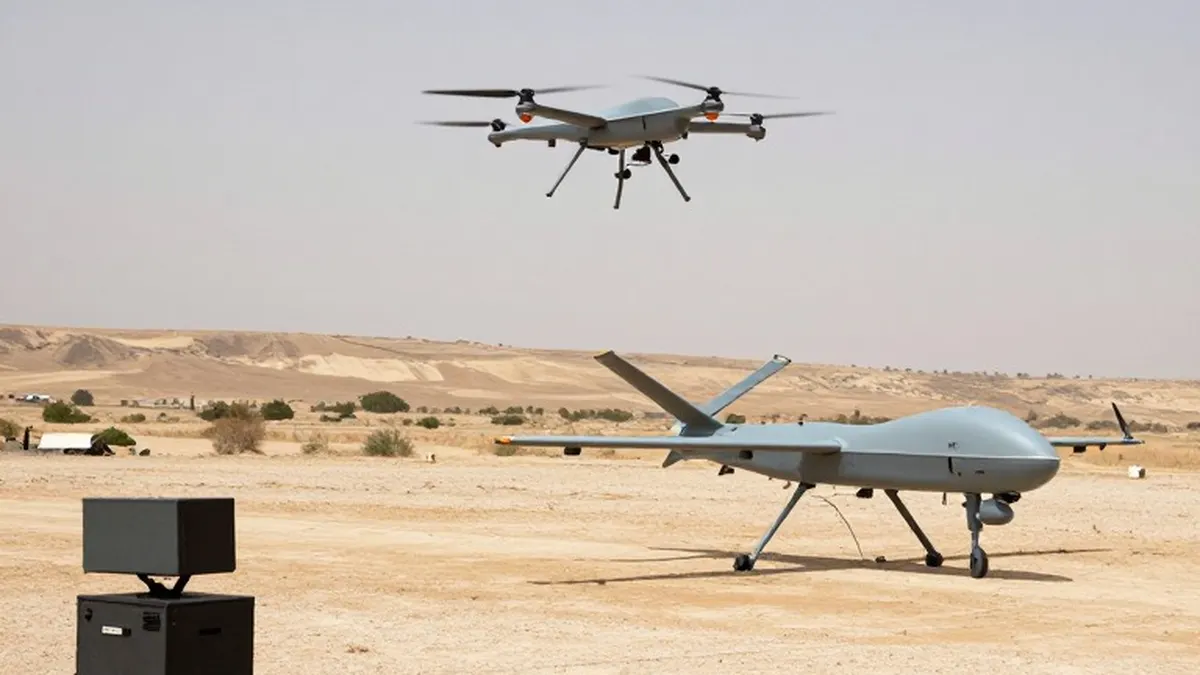
Israel and the United States have conducted their first joint experiment testing about 20 systems designed to intercept advanced drone threats, Israel's Defense Ministry announced on Thursday, November 26. The trials brought together military research bodies and private security companies from both countries to assess technologies against operational challenges faced by their forces.
The experiments took place in Israel as part of Black Sands, an ongoing campaign of jointly managed technological military exercises. The ministry did not specify when the tests occurred. The Jerusalem Post said it had requested clarification but had not received a response at the time of publication.
The effort comes as increasingly sophisticated drones challenge existing defenses. Israel encountered Hezbollah's first-person view, or FPV, drones in early 2026, including aircraft controlled through fiber optic cables that could overcome Israeli jamming tactics. The United States, meanwhile, has observed Russia and Ukraine introduce a variety of advanced drones and combat methods that make interception more difficult.
Hezbollah's FPV drones killed or wounded more Israeli soldiers in 2026 than several hundred Iranian ballistic missiles, despite the missiles being technically more deadly. Israel was better prepared to counter the ballistic missile threat. Following unexpectedly high casualties from FPV drones earlier in the year, the ministry and other reports described Israeli work on specialized infantry guns, protective netting, cable-cutting equipment, and new radar and interception systems.
Organizations involved in Black Sands included the Development and Innovation Directorate, US Central Command, its Special Operations Command, the Office of Naval Research and Joint Interagency Task Force 401, which works to streamline advanced weapons testing. Leading Israeli and American private security companies also participated. According to the ministry, the trials used scenarios reflecting both countries' threats and operational difficulties, with direct involvement from military personnel who would use the equipment.
The ministry presented the experiments as part of its strategy to preserve Israel's qualitative and strategic advantage, strengthen its defense technology assets and broaden international security cooperation. It also said the US Defense Department's Development and Innovation Directorate, which develops asymmetric warfare capabilities against state and non-state actors, had worked with Israel for years on technologies including drone interception and control.
Brigadier General in the reserves Danny Gold, who heads the ministry's Directorate of Defense Research and Development, said countering unmanned aircraft demands continual technological innovation and close cooperation with partners. He said the event combined knowledge and operational experience acquired in Israel with additional capabilities and technologies, while allowing joint testing tied to the needs of forces in the field.
Benny Aminov, head of the directorate's Military Research and Development Unit, described the drone challenge as shaped by widely available civilian technology and a continuous need to learn. He called the experiments an important step in developing both countries' forces and said the partnership provided Israel with a strategic asset while giving the United States access to distinctive technology and operational experience.