
Euclid mission maps 900 million galaxies in historic data release
The Euclid mission's first major data release maps over 900 million galaxies and identifies thousands of gravitational lensing events to help solve mysteries of dark matter and dark energy.
By Amir Navarro ·
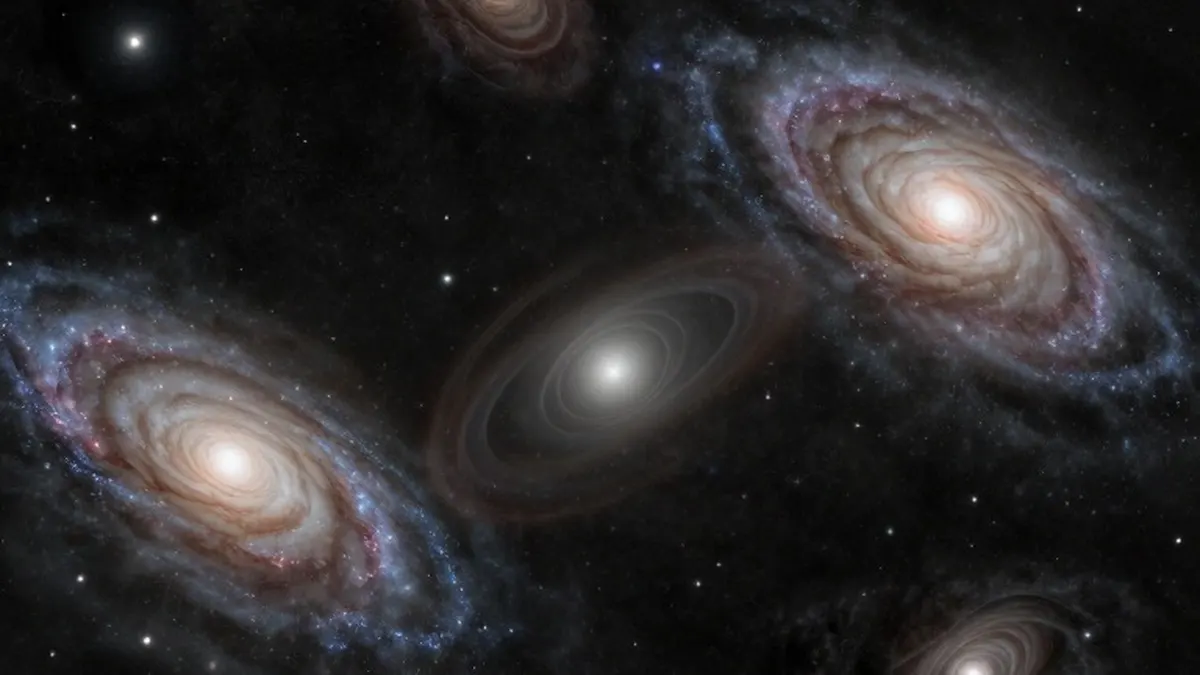
The European Space Agency's Euclid mission has released its first major dataset, revealing a detailed 3D map that includes over 900 million galaxies. This significant release also identifies approximately 15,000 potential instances of strong gravitational lensing, a phenomenon that may provide critical insights into the nature of the dark universe.
Launched in July 2023, Euclid was designed to create the largest cosmic map to date, covering one-third of the sky and spanning more than 10 billion years of cosmic history. The primary objective of the mission is to investigate two of the most profound mysteries in cosmology: dark energy and dark matter. Current estimates suggest that these invisible components constitute roughly 70% and 25% of the universe, respectively.
Prof Andy Taylor, who leads the UK science ground segment for the mission at the University of Edinburgh, highlighted the unique capabilities of the spacecraft. He noted that while previous surveys were larger, none matched the combination of detail and information content provided by Euclid. In comparison, the Hubble Space Telescope offers images of incredible resolution but covers a much smaller area of the sky.
Taylor explained that the technological advancement of Euclid allows it to maintain high resolution while mapping vast volumes of the universe. He described the new data as the biggest high-resolution image of the cosmos ever produced. The initial release covers about 14% of the total sky area that Euclid will eventually map, capturing not only the 900 million galaxies but also more than 60 million potential quasars, which are powered by supermassive black holes at the centers of distant galaxies.
A key component of this data release is the identification of candidates for strong gravitational lensing. This effect occurs when a foreground galaxy, often within a cluster, sits in front of a more distant galaxy. According to Einstein's theory, the gravitational pull of the foreground object distorts space-time, bending the light from the background galaxy into bright arcs or rings. This magnification is significantly enhanced by the presence of dark matter, which increases the total mass and gravitational influence of the galaxy.
Researchers believe that studying these lensing events can help rule out various theories regarding the nature of dark matter. The distribution of this mysterious substance within a galaxy affects how the lensing occurs, and that distribution depends on the specific properties of the dark matter itself.
Stephen Serjeant, a professor of astronomy at the Open University, supported this view. He stated that strong gravitational lensing reveals how dark matter clumps together, which is highly diagnostic of the type of matter involved. Different types of matter exhibit different clumping behaviors, so analyzing these patterns could lead to a breakthrough in understanding what dark matter actually is.
While experts previously identified only about 1,000 cases of strong gravitational lensing, the Euclid data contains around 15,000 probable cases. Taylor indicated that an estimated 170,000 such cases are expected to be discovered by the end of the mission.
A further data release is anticipated in the summer of 2027. This upcoming release will include results on the distribution of galaxies as well as weak gravitational lensing, which involves subtle distortions caused by foreground dark matter. Taylor explained that scientists can use these distortion patterns to create a map of where all the dark matter is located in the universe, allowing them to compare statistical properties against different theoretical models.
As Euclid continues to generate massive amounts of data, the volume of information is becoming too large for human eyes to process alone. Taylor noted that the mission is opening up high-resolution views of the entire sky, revealing numerous objects and research phenomena that have never been seen before.