London car use projected to climb 10% over next decade
Official forecasts suggest car trips in London will rise by 10% by 2036, challenging the mayor's environmental pledges and highlighting potential congestion issues.
By Vanessa Lopez ·
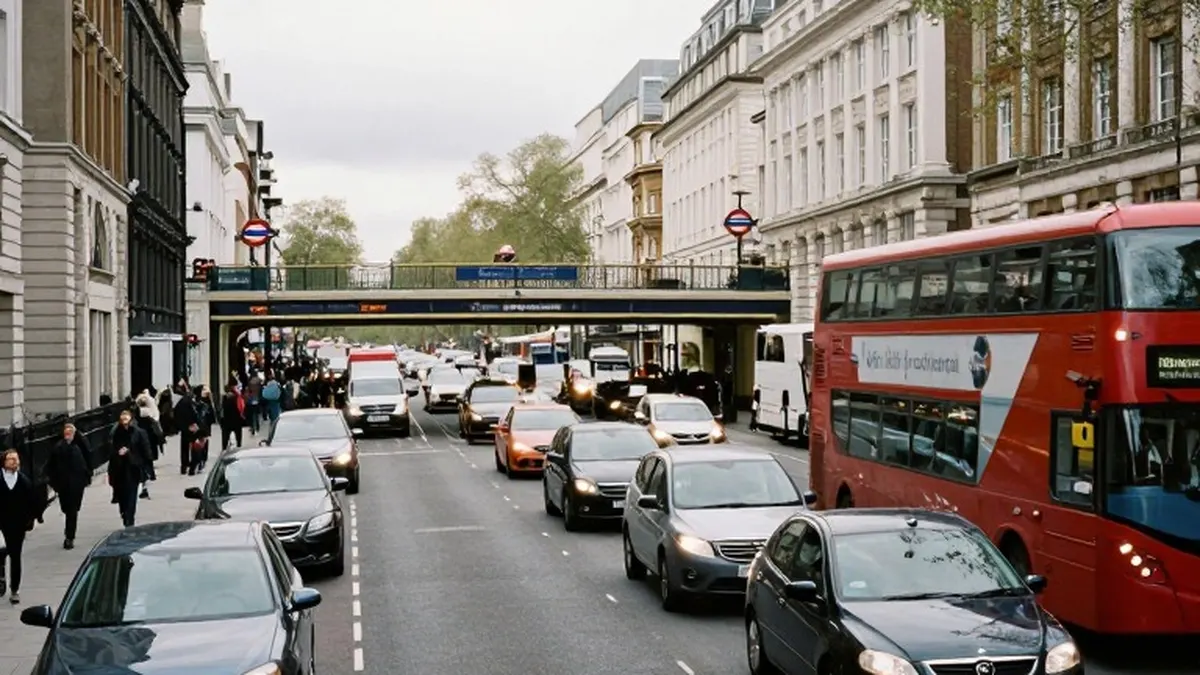
Official projections from the London mayoralty indicate that car usage in the capital will increase by 10 percent over the next ten years. This forecast, based on the draft of the latest 10-year London plan, suggests that cycling and walking will represent a smaller share of total trips. The data raises questions about the progress being made toward air quality and environmental targets set by Mayor Sadiq Khan.
The projections were developed by the mayor’s office and Transport for London. They assume that the city’s growing population will lead to increased road congestion. This slowdown is expected to affect bus services. Additionally, severe overcrowding on the Tube could force authorities to close stations or run non-stopping trains during peak periods to manage passenger numbers.
The draft plan for 2026 to 2036 outlines three possible models for growth in population and employment. The central model, considered the most likely scenario, predicts that London’s population will rise from the current 9.1 million to 9.9 million. Under this scenario, trips made by car or other motor vehicles would increase by 10 percent between 2023 and 2036. Trips using public transport are expected to rise by 17 percent.
Journeys made by walking or cycling would see a 6 percent increase. However, because motor vehicle and public transport trips are growing at a faster rate, active travel would constitute a slightly smaller proportion of all journeys. This trend would place London at odds with other major European cities. For example, in Paris, the share of trips made by bicycle nearly tripled over a five-year period.
Mayoral officials argue that the figures represent a modelling exercise rather than a definitive prediction. They state that the model assumes no new transport policies are introduced and does not account for recent changes, such as the pedestrianization of Oxford Street. The expectation remains that active travel levels will eventually increase and car use will decrease.
The report highlights significant challenges associated with increased car journeys. Average road speeds could fall by 7 percent, which would further slow down bus routes. Overcrowding on public transport is also expected to become more common. On the underground network, severe congestion at certain stations may require regular interventions during peak demand periods.
These modelling results cast doubt on the mayor’s 2022 pledge to reduce car use across London by 27 percent by 2030. Ralph Smyth, a strategy adviser for the Transport Action Network, noted that progress in shifting the capital away from car dependence appears to have stalled. He described the new plan as an opportunity for the mayor to leave a legacy of a cleaner and less congested city, but suggested the current direction moves in the opposite direction.
Critics argue that while the expansion of the ultra-low emission zone has improved air quality, the city still lags behind other European capitals in transport efficiency. Jenny Bates, a campaigner for Friends of the Earth, pointed out that the transition to electric vehicles will take many years and will not solve congestion issues. She emphasized the need to reclaim space for safer walking and cycling routes and more urban greenery to help cool the city during hot summers.
Simon Munk, head of campaigns for the London Cycling Campaign, warned that the plan risks modeling a future that is already outdated. He argued that Transport for London should focus on land-use planning and transport policy to significantly reduce car use, rather than modeling for ongoing heavy reliance on private vehicles.
A spokesperson for the mayor stated that City Hall expects active travel to increase significantly by 2036 and car use to fall. The modelling is based on a scenario where no additional active travel schemes are introduced, a condition the spokesperson said is not currently the case. The results are intended to help identify what future transport schemes may be required.