Bronze leg offers fresh evidence of Roman power in Scotland
An exhibition in Edinburgh presents a new interpretation of a bronze statue fragment and explores how Roman occupation influenced Scotland’s art and politics.
By Amir Navarro ·
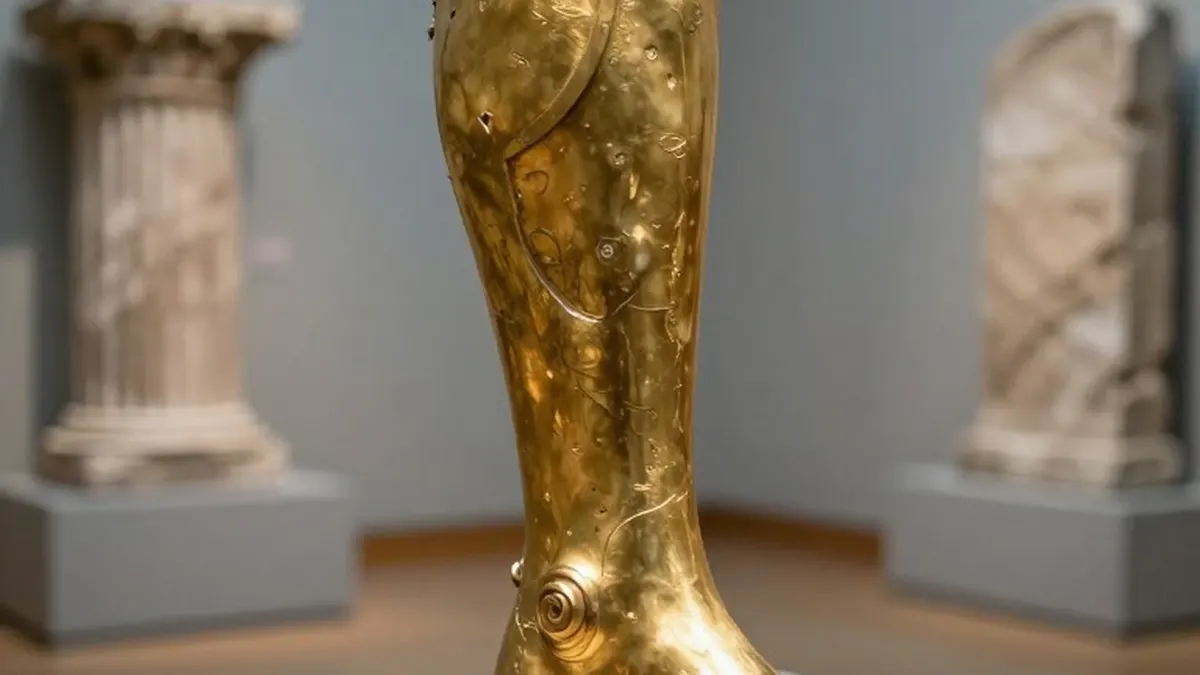
A gilded bronze leg recovered from a Scottish bog in 1820 is changing archaeologists’ understanding of Roman influence north of Hadrian’s Wall. Researchers now believe the fragment belonged to a huge equestrian statue of Emperor Antoninus Pius erected near Hawick after Roman armies took control of southern Scotland around AD140.
Known as the Mislington leg, the object was previously interpreted as plunder brought north by Scottish tribes, possibly after being cut from a statue in York. Following its discovery, it spent a century in the charter room at Dalkeith House near Edinburgh, a residence belonging to the Duke of Buccleuch. Similarities with imperial statues elsewhere along Rome’s frontiers now support an origin in the Scottish Borders.
The limb is the centrepiece of Roman Scotland: Life on the Edge of Empire, which opens on Saturday at the National Museum of Scotland in Edinburgh. Described as the largest exhibition devoted to the Romans in Scotland, it brings together objects that curators say demonstrate the extent of Roman occupation and its lasting cultural and political effects. Principal curator Dr Fraser Hunter believes the leg was deliberately detached and deposited, rather than violently hacked away, some 1,700 years before its discovery.
Hunter argues that monumental statues would have made a striking impression on iron-age communities, whose art rarely portrayed people naturalistically. The exhibition also features a newly reconstructed, elaborately decorated earthenware bowl from Inveresk, east of Edinburgh. Assistant curator Bethany Simpson said its combination of dolphins, stags and a stylised hunting dog was unique to Inveresk, with no equivalent elsewhere in the UK.
Inveresk contained a substantial Roman fort and town. Hunter considers it a centre of imperial authority during the Antonine occupation of AD142 to 165, the second of Scotland’s three periods under Roman occupation. He estimates that southern and eastern Scotland held about 10,000 soldiers, including auxiliaries from areas now known as Romania and north Africa, with perhaps another 10,000 camp followers, wives and enslaved people.
Two exceptionally well-preserved stone altars, carved locally and excavated from a temple of Mithras at Inveresk, are also being exhibited for the first time. Lighting evokes their original painted colours. One hollowed altar has openings around the carved head of Mithras, including holes in the eyes and mouth, through which lamplight could shine. A complete horse skeleton from a careful burial at Inveresk is another exhibit. Hunter said such treatment of cavalry horses was unusual in Britain and suggested the animal was particularly valued.
The exhibition traces connections between Roman occupation and later indigenous art. Recent scholarship suggests that pre-Roman Scotland lacked a carving tradition, while contact with Rome helped inspire native styles that eventually produced ornate Pictish standing stones. Inveresk also had a small amphitheatre, an uncommon feature of frontier towns.
Roman influence extended to relations with Celtic rulers, who were attracted to silver, a material previously unknown locally that Rome used to secure loyalty. By the third and fourth centuries, however, the threat from Rome encouraged Pictish tribes to unite against it. Hunter argues that Roman intervention helped produce larger political groupings whose own symbols and artistic expression drew creatively on encounters with Roman sculpture and writing.